
Signing a mortgage is a 20 or 30-year decision. What you choose today will determine your financial peace of mind for decades. Let's analyse the current panorama with up-to-date data from the National Institute of Statistics (INE).
The current situation according to INE
According to the latest data published by the National Institute of Statistics (INE), fixed-rate mortgages represent between 60% and 70% of new signings, compared to 30% - 40% for variable rates. Mixed mortgages occupy a minority percentage but are growing.
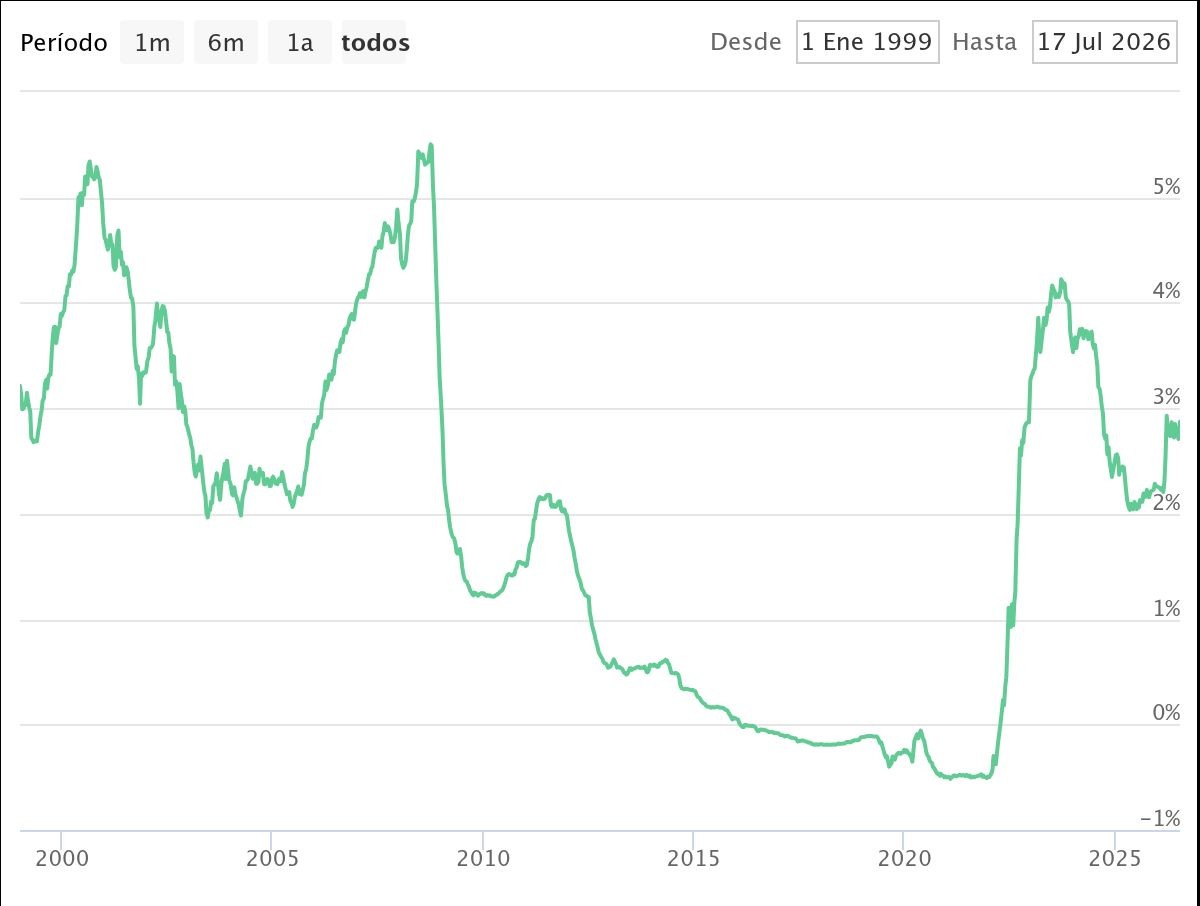
12-month Euribor chart:
The historical evolution: three clear phases
Phase 1: Absolute predominance of variable rate (Until 2015)
Historically, in Spain more than 90% of mortgages were signed at variable rate (referenced to Euribor). This model prevailed for decades, taking advantage of periods of low Euribor rates.
Historical evolution of Euribor (1999-2008):
- Start of the index: Euribor starts with the birth of the euro in 1999.
- First high peak: In August 2000 it exceeds 5.24% due to the tech boom.
- Absolute historical maximum: In July 2008, dragged by the subprime mortgage crisis, the 12-month Euribor climbs in the chart to touch its historical ceiling of 5.393%.
Phase 2: The rise of fixed rate (2016 - 2022)
After the financial crisis and the Mortgage Credit Contract Law of 2019, banks pushed the fixed rate. By 2021 and early 2022, more than 70% of new mortgages were fixed rate, reaching historic lows of interest.
Euribor decline - Era of Negative Territory (2009-2021):
- Free fall: The European Central Bank (ECB) cuts interest rates drastically to reactivate the economy after the economic crisis.
- Historical zero point: In February 2016, the index breaks barriers and enters negative values for the first time (-0.008%).
- Historical minimums: During the 2020 pandemic and throughout 2021, rates sink in the chart to reach levels close to -0.50% due to massive liquidity injections by the ECB.
Phase 3: The mixed rebound and current stabilisation (2023 - 2026)
Faced with strong rises in official interest rates, fixed rate became more expensive, pushing many buyers towards the mixed type (fixed for the first 3-10 years and variable thereafter) to avoid initial uncertainty. By the end of 2025 and beginning of 2026, the proportion has stabilised at around 65% for fixed rate and 35% for variable/mixed.
The Inflationary Surge and Normalisation (2022-2026):
- Radical turn (2022): Euribor leaves negative territory in April 2022 after monetary policy tightening due to inflation.
- Recent peak (2023): The chart again draws a very steep upward slope, reaching an intermediate high of 4.16% in October 2023.
- Current stabilisation (2024-2026): After the start of rate cuts by the ECB, the indicator is currently trading more moderately, moving between ~2.5% and ~3.0% (around 3%).
Fixed Rate: Peace of mind comes at a price
For years, the fixed rate was king. Now, banks have made it more expensive due to the rise in official rates. Is it still worth it? If you are conservative and value sleeping peacefully knowing your payment will NEVER change, yes. Look for offers below 3% TIN.
Variable Rate: For the daring
Nowadays it may seem attractive because the differential is low, but you are exposed to Euribor. If rates fall, you gain; if they rise, you suffer. Historically it is cheaper, but requires having a safety cushion.
Mixed Rate: The new protagonist
A mixed mortgage offers you 5, 10 or 15 years at fixed rate (with a very competitive interest) and the rest variable. It is an excellent strategy to protect yourself in the first years, which is when you pay the most interest (due to the French amortisation system), and then see what happens. It currently represents an increasingly popular option among those seeking to balance initial security and future flexibility.
The Expert's Tied selling trick
Watch out for the tied selling. Sometimes the bank lowers your interest rate in exchange for contracting THEIR life insurance and THEIR alarm. Do the maths: sometimes it is cheaper to pay a bit more on the mortgage and contract the insurances yourself at half price.